

3 Key Supply Chain Management Strategies of Apple
- Upon taking office, Tim Cook built the foundation of Apple's formidable global supply chain through steps such as transitioning to China-centered outsourced production, downsizing factories and warehouses, and executing large-scale advance purchases.
- Apple's core procurement organization, GSM, thoroughly designs and controls costs and the supply chain through three key strategies: Should-Cost instead of price negotiation, asset-light operations paired with production line exclusivity, and an aggressive JIT inventory system.
- As a result, Apple achieved an unmatched inventory turnover rate and drove explosive corporate value growth, including a 14-fold increase in market capitalization over the past 15 years.

Having led Apple for 15 years, Tim Cook recently handed over the CEO position to John Ternus and moved to the role of Chairman of the Board.
A procurement expert by background, he was appointed CEO in 2011 as the successor to Steve Jobs.
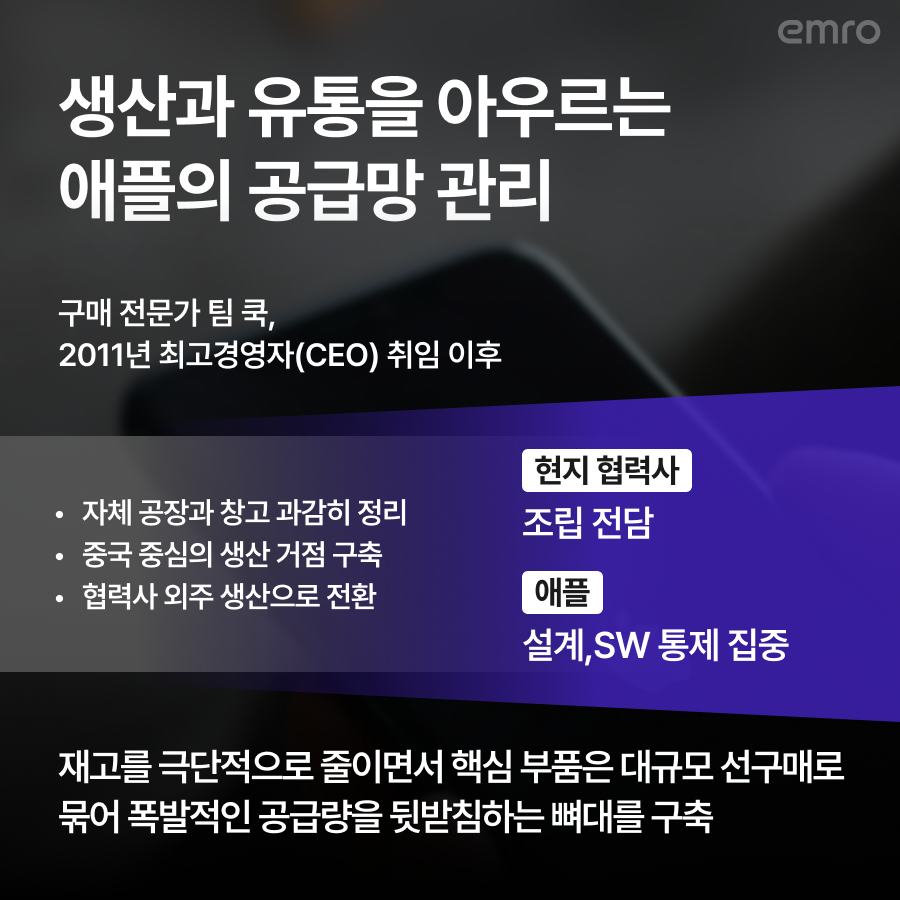
Tim Cook's greatest weapon was supply management encompassing production and distribution.
In fact, after taking office, he boldly phased out his own factories and warehouses, established a production base centered on China, and shifted to outsourced production through partners.
By drastically reducing inventory while locking down core components through large-scale advance purchases, he built a solid framework to support the explosive supply volumes of future iPhones and iPads.
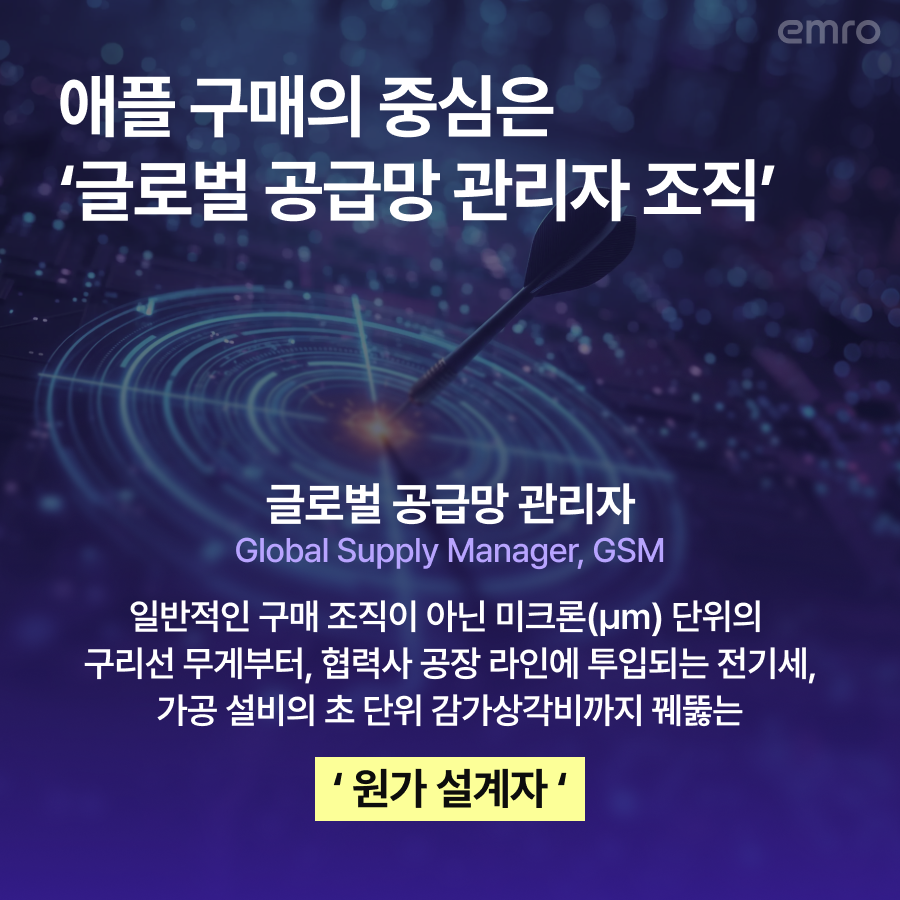
Instead of a general procurement organization, Apple maintains an internal group called Global Supply Managers, or 'GSMs'.
They are cost designers who thoroughly understand everything down to the weight of micron-sized copper wires going into parts, the electricity bills poured into partner factory lines, and the second-by-second depreciation costs of processing equipment.
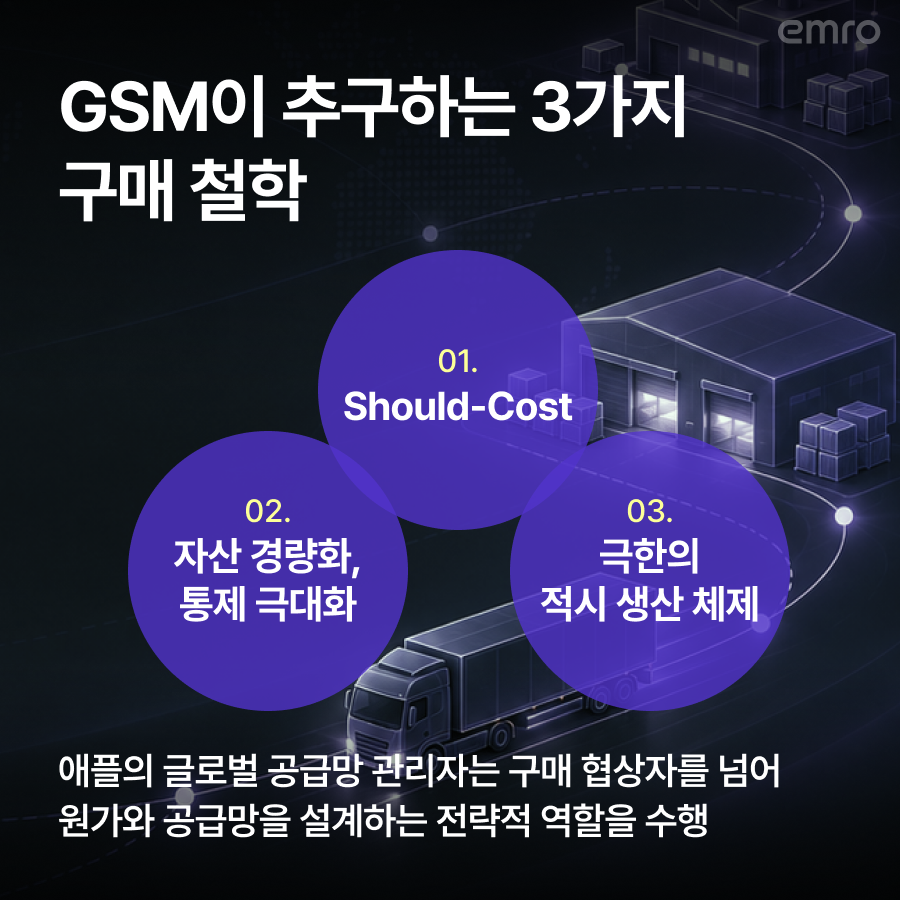
GSMs do not negotiate unit prices with suppliers. Instead, they play a strategic role in designing costs and supply chains.
Through the three procurement strategies pursued by GSMs, we can catch a glimpse of Apple's purchasing philosophy.
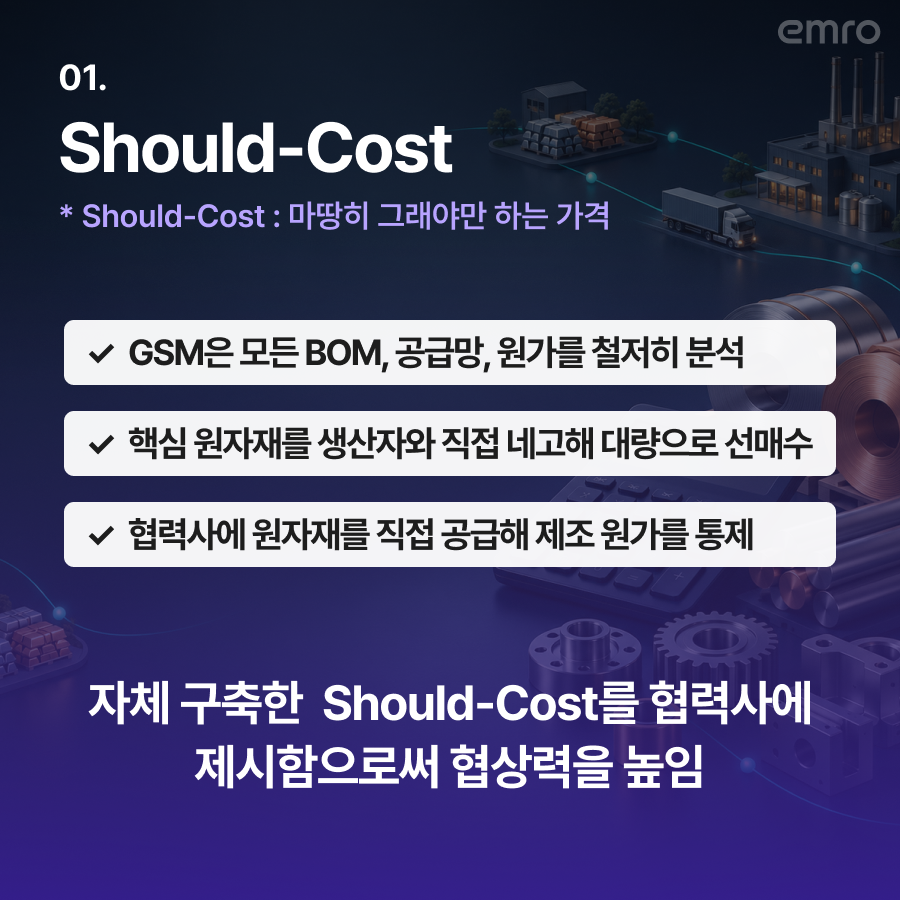
The first is 'Should-Cost' (the price that should naturally be).
Apple's GSMs precisely know all the processes and costs of their partners. This is because they thoroughly analyze the bill of materials (BOM) required to make products, alongside the partners' supply chains and costs.
Furthermore, they pre-purchase core raw materials in bulk and supply them to partners. Through this, they directly control manufacturing costs.
Instead of negotiating with partners based on quotations, Apple presents its self-established Should-Cost and enhances its bargaining power by guaranteeing enormous volume and reasonable margins to partners.
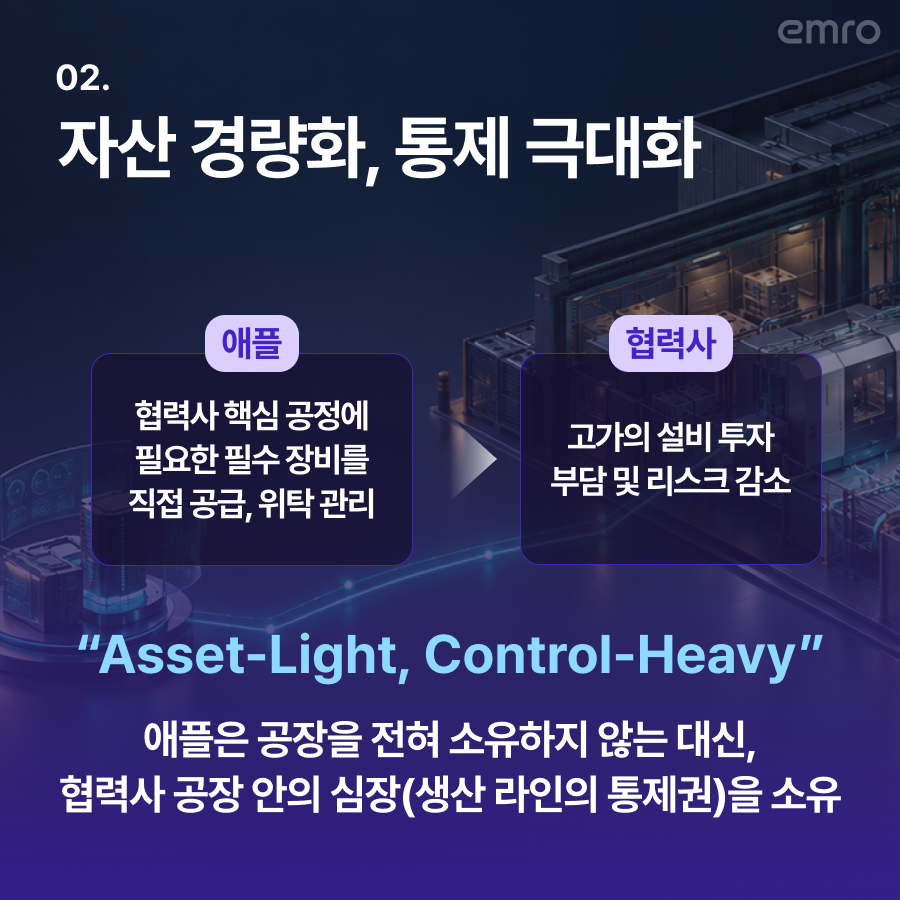
The second is the 'Asset-Light, Control-Heavy' strategy.
Apple does not own factories. Instead, it directly supplies essential equipment required for partner core processes and manages them on consignment. Through this, partners can reduce the risk of expensive facility investments, while Apple can secure control over the production lines.
In other words, Apple monopolizes the partners' production lines.
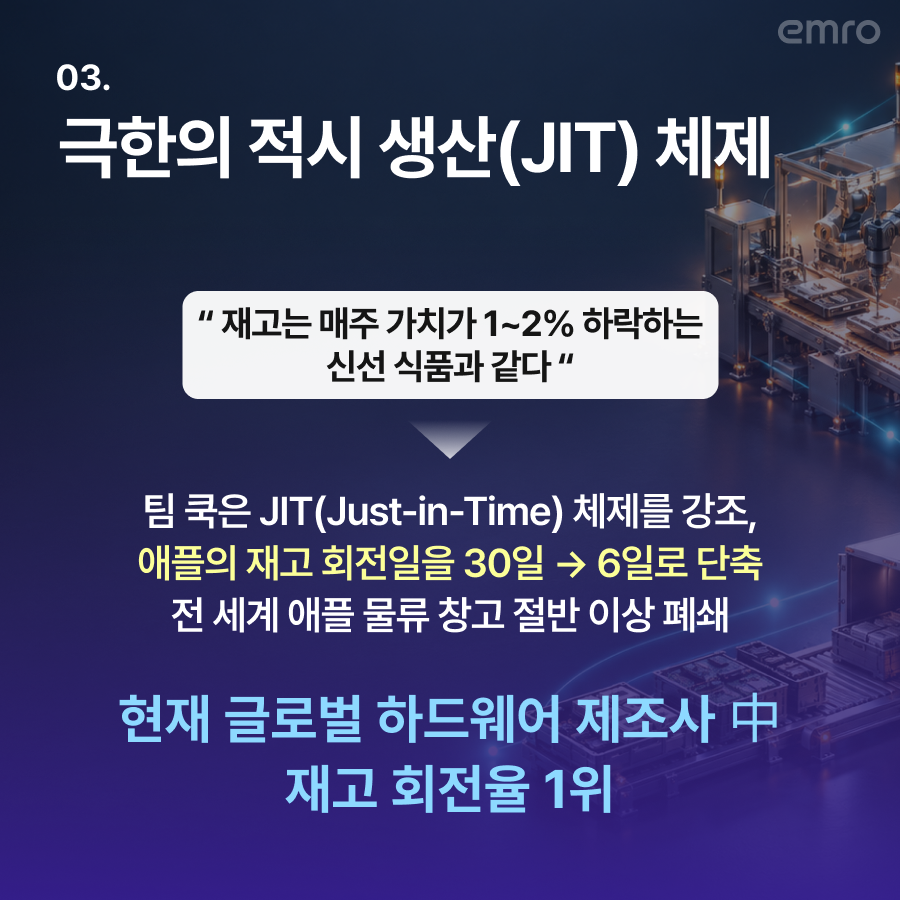
The last is the extreme Just-in-Time (JIT) production system.
Immediately after taking office, Tim Cook emphasized the JIT system, reducing the inventory turnover days from the previous 30 days down to 6 days within 7 months. More than half of Apple's logistics warehouses scattered across the globe were also closed down.
Thanks to these strategies, Apple's inventory turnover rate currently ranks an undisputed 1st among global hardware manufacturers.
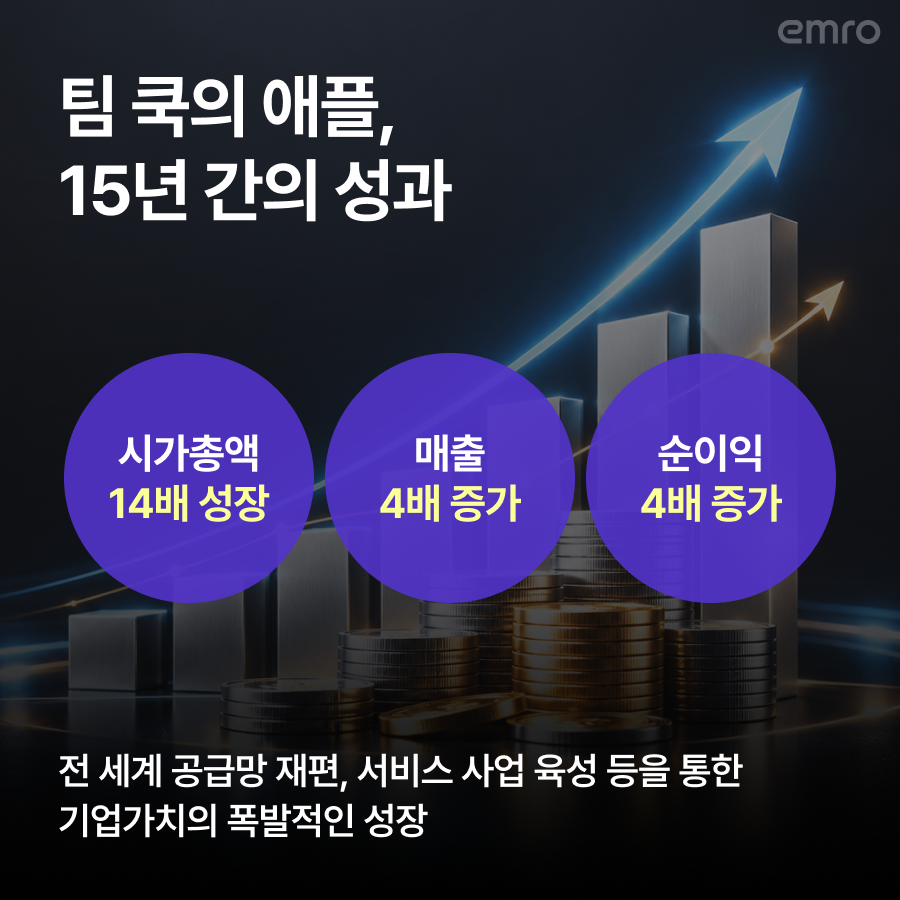
The achievements Tim Cook left at Apple over the past 15 years are also confirmed by numbers.
Compared to 2011 when he took office as CEO, the market capitalization has grown more than 14 times, and revenue and net income have each increased nearly fourfold.
How would you evaluate the purchasing philosophy of Tim Cook and GSMs, who reorganized the global supply chain, fostered the service business, and explosively grew Apple's corporate value?


