

What is a 'Value Chain Architect'?: The Evolution of Procurement
- Moving beyond simple negotiation and cost reduction, procurement organizations are expanding toward a corporate value-centric mindset and evolving into the highest stage: the 'Value Chain Architect.'
- This signifies breaking away from the traditional role of simply purchasing goods to taking the lead in the enterprise-wide value chain and playing a key role in contributing to corporate business strategy and growth.
- In today's enterprises, procurement organizations have established themselves as pivotal strategic departments that design and optimize the entire supply chain, going far beyond mere support functions.
As this column reflects the subjective views of an external writer, it may differ from the editorial direction of the Emro blog.
From the perspective of procurement organization growth, the role of procurement goes beyond simply improving negotiation skills; it is a process of expanding from a procurement-centric mindset to a corporate value-centric mindset. In this context, I would like to introduce the concept of its highest stage, the Value Chain Architect.
First, if we map out the stages of procurement organization growth, they are as follows.
|
Level |
Role |
Perspective |
|
Level 1 |
Buyer |
“Buying well” |
|
Level 2 |
Strategic Sourcing |
“Buying competitively” |
|
Level 3 |
Category Manager |
“Designing the supply market” |
|
Level 4 |
Supply Chain Leader |
“Optimizing the supply chain” |
|
Level 5 |
Value Chain Architect |
“Designing corporate competitiveness” |
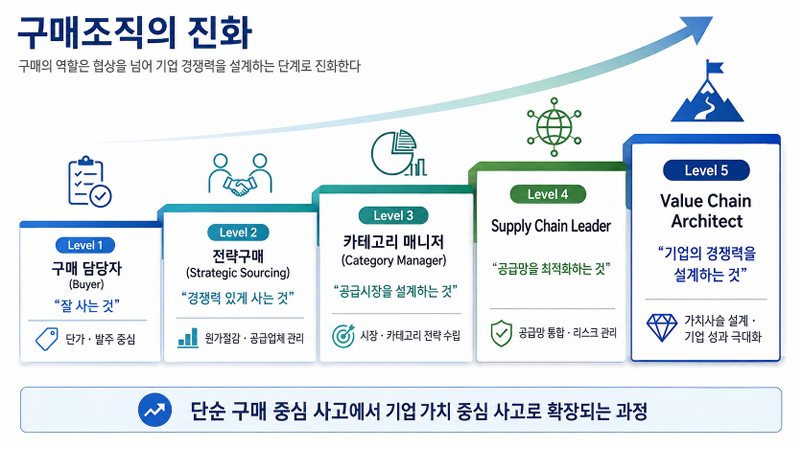
The ultimate evolution of procurement is 'redesigning corporate value.'
From the perspective of procurement organization growth, I consider the Value Chain Architect to be the final evolutionary stage of procurement. In other words, it is most accurate to understand the Value Chain Architect not as a new job title, but as the role and mindset attained by top-tier strategic procurement professionals.
The competitiveness of procurement organizations now requires the ability to design markets and supply chains beyond mere negotiation capabilities, and the future of procurement organizations is evolving from a 'Cost Center' into a 'Value Chain Architect.' The Value Chain Architect is a concept that expresses the role expected by advanced manufacturing enterprises from their procurement/SCM organizations. Simply put, it is "not the capability to purchase goods cheaply, but the capability to design and optimize the corporate value chain."
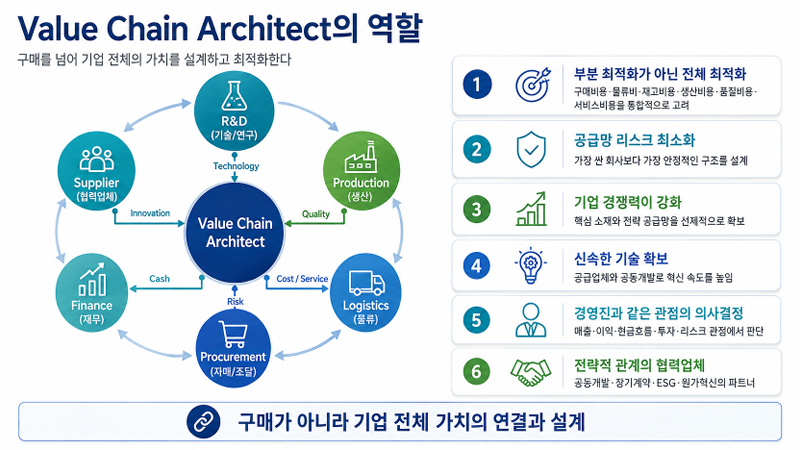
Core Roles of the Value Chain Architect
① Total Optimization, Not Partial Optimization
Total profit increases by considering all procurement costs, logistics costs, inventory costs, production costs, quality costs, and service costs together.
② Minimization of Supply Chain Risks
It designs a structure where "supply is most stable" rather than just choosing "the company with the lowest price."
③ Enhancement of Corporate Competitiveness
For semiconductors, rare earths, and core materials, securing the supply chain first determines competitiveness.
④ Rapid Technology Acquisition
Conducting joint development with suppliers that have developed new materials makes it difficult for competitors to catch up. In other words, procurement becomes the starting point of technological innovation.
⑤ Decision-Making from the Same Perspective as Management
While procurement professionals only look at prices, management looks at sales, profit, cash flow, investment, and risk. The Value Chain Architect also makes decisions from this same perspective.
⑥ Strategic Supplier Relationships
While traditional procurement focused centered on price negotiations, it evolves into joint development, co-investment, long-term contracts, ESG improvement, and cost innovation, transforming suppliers from mere transaction accounts into strategic partners.
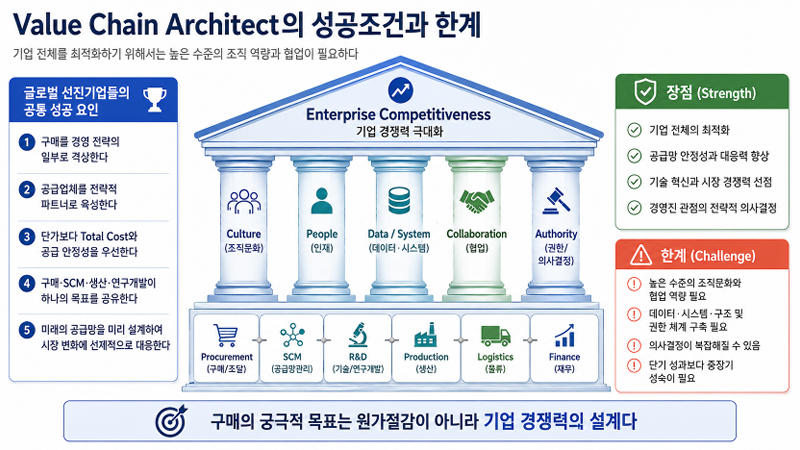
The best way to understand the Value Chain Architect is to examine how actual enterprises have transformed procurement into a strategic function. Almost no company officially states, "We have introduced the Value Chain Architect." What matters is whether world-class manufacturing enterprises are practicing the exact same concept through Strategic Sourcing, Supply Chain Management (SCM), Supplier Collaboration, and value chain optimization.
Common Success Factors of Value Chain Architect Success Stories
① Elevating procurement as a part of business strategy.
② Fostering suppliers as strategic partners rather than mere transaction targets.
③ Prioritizing Total Cost and supply stability over unit prices.
④ Operating procurement, SCM, production, and R&D to share a single common goal.
⑤ Preemptively designing future supply chains to respond proactively to market changes.
Ultimately, the Value Chain Architect refers to a designer who connects purchasing, sourcing, production, logistics, technology, and finance into a single value chain to maximize the overall performance of the enterprise. From this perspective, the ultimate goal of procurement is not cost reduction, but the design of corporate competitiveness—which is the most critical role global leading manufacturing enterprises expect from their procurement organizations today.
The Value Chain Architect is not a concept with only advantages. While it is a powerful approach that can significantly enhance corporate competitiveness, it requires organizational culture, talent, systems, and authority to back it up; otherwise, it can rather complicate decision-making and cause organizational confusion. The advantage of the Value Chain Architect is optimizing the entire enterprise, while the disadvantage is that executing it requires an exceptionally high level of organizational capability and collaboration.


